Showing posts with label wetlands. Show all posts

1.01.2014

EGRET FAMILY VALUES


GREAT EGRET (Ardea alba)
Location: St. Johns County FL
Photo: © 2004 Jeffrey Berger

When planning your nest egg for the best of times or the worst of times, here is a bit of savvy investment advice from a native bird. It is always best to hedge your bets by hatching more eggs than you will need. Whether breeding or investing, it is a time-honored strategy perfected over millions of years.

Most large birds - such as eagles, egrets, or herons - will produce more eggs than they are capable of raising. Since all eggs need the same time to incubate regardless of when they are laid, Mamma Egret starts incubation after the first egg is laid and continues laying her full clutch over a series of days. Thus, the first egg hatches first, the last egg hatches last, and not all chicks start life as equal opportunity egrets.

The first-born hatchling has no competition for food and grows rapidly. Chicks born later are sequentially smaller and less capable of competing for food against the older siblings. Even in the best of times, only the older chicks will survive while the youngest will waste away. During routine housekeeping, parents will toss the expired chicks overboard, which inevitably become snacks for waiting gators. This phenomenon is known as ‘brood reduction.’

3.01.2011

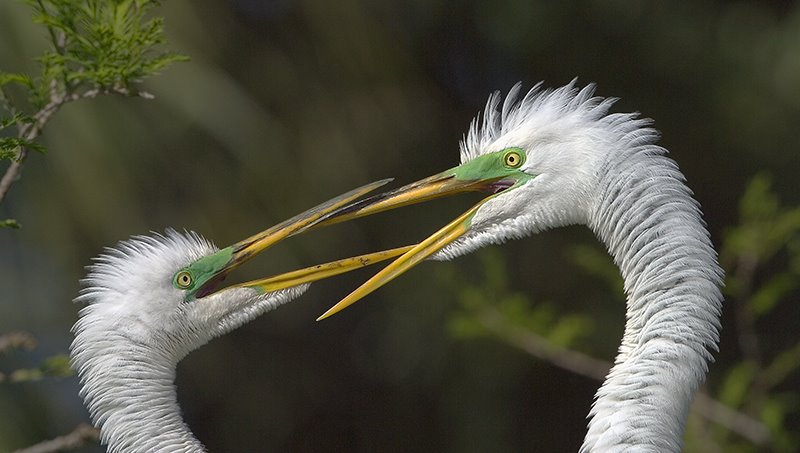
DANCING BEAK TO BEAK


Great Egret (Ardea alba)
Photo: © 2004 Jeff Berger

For the great egret, the breeding season begins when hormones cause the bare skin around the beak and eyes to change from yellow to green. The male builds a makeshift nest and invites a female to cohabitate thus signaling courtship. The nuptial pair announce their reproductive readiness by crossing beaks and fluffing up their feathers.

2.01.2011

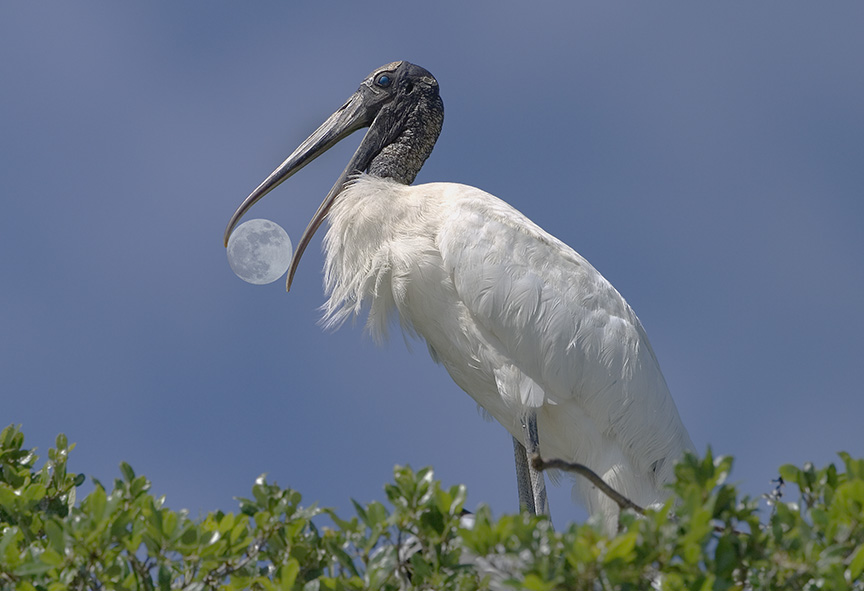
NORTH AMERICAN WOOD STORK


Scientific name: Mycteria americana
Photo: © 2004 Jeff Berger

The only stork found in North America is an endangered bird and one of my favorites. When walking or wading, they skulk around appearing serious and grim; I call them graveyard birds. When airborn, the wood stork is a truly magnificent flier - soaring from thermal to thermal on outstretched wings spanning five to six feet across. The nicknames “Flinthead” and “Ironhead” describe the slate-grey skin covering the neck and head.

Wood storks are especially susceptable to natural and man-made events. Storms and cold spells may lead to nest desertion. Racoons may predate eggs and fledglings. Major threats to long-term survival include loss of wetlands due to development and disruptive water management practices that alter their reproductive cycle.

Like other native birds, the wood stork depends upon gators to protect the breeding colony from tree-climbing predators.

10.01.2010

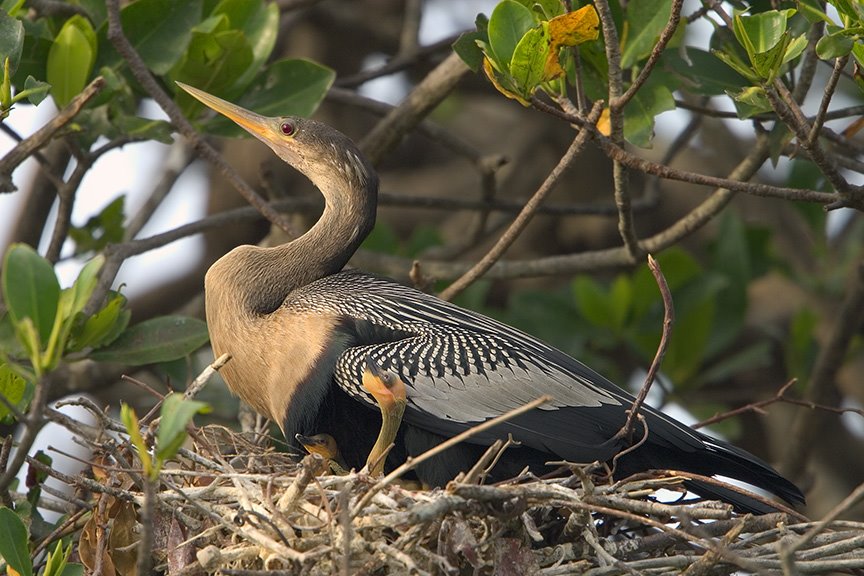
ANHINGA MOTHER


Scientific name: Anhinga anhinga
Location: Indian River Lagoon
Photo: © 2005 Jeffrey Berger

Anhinga mothers will lay an average of 3 to 5 eggs per nest spaced a day or two apart. Since incubation begins with the first egg, hatchlings will vary in age and size resulting in brood reduction.

The Anhinga has earned various nicknames depending upon how you experience one. Veteran boaters call it the “snakebird.” It earns this nickname by swimming submerged with only its neck and head undulating above the waterline like a serpent. The lack of waterproof plumage enables it to travel effortlessly underwater in search of fish, but for every advantage there is also a hitch. When soaked to the skin, the Anhinga looses body heat and must find a nearby perch to warm itself after feeding. With spread wings and fan-shaped tail feathers drying in the sun, the Anhinga earns its other nickname, “water turkey.”

9.20.2010

ZSA ZSA RETURNS


Roseate Spoonbill (Ajaia ajaja)
Location: Brevard County
Photo: © 2008 Jeffrey Berger

Ahh, my favorite roseate spoonbill is back ... as pink and sassy as ever!

8.01.2010

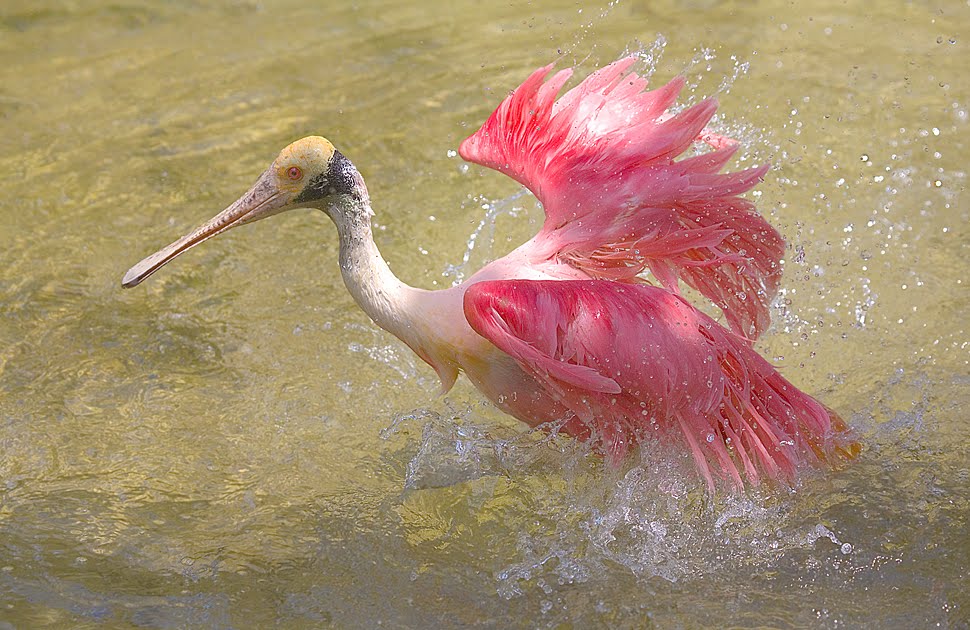
MEET ZSA ZSA


Roseate Spoonbill (Ajaia ajaja)
Photo: © 2004 Jeffrey Berger

Zsa Zsa is a beautiful and flamboyant bird, and the only spoonbill native to North America. The term “Roseate Spoonbill” refers to the rose-colored feathers and spatula-shaped beak. She is a tactile feeder who snatches aquatic insects and crustaceans from shallow water.

The spoonbill was almost exterminated in the last century. The demand for colorful plumes by the fashion industry had driven up the price of feathers to more than twice their weight in gold. Plume hunters armed with clubs and guns plundered the rookeries and slaughtered birds by the thousands. Today, spoonbills are threatened by the loss of feeding and nesting habitats due to unmanaged growth.

3.13.2008

WHITE IBIS


White Ibis (Eudocimus albus)
Photo: © 2008 Jeffrey Berger

6.04.2007

A PELICAN BRIEF


Brown Pelican (Pelecanus occidentalis)
Location: Longpoint, Melbourne Beach
Photo: © 2004 Jeffrey Berger


American White Pelican (Pelecanus erythrorhynchos)
Location: Indian River Lagoon at Sebastian
Photo: © 2004 Jeffrey Berger

Our ubiquitous Brown Pelican has often been described as solemn, dignified, comical, and pompous. When pouched bills are pressed against breast, I think of them as pterodactyls masquerading as English butlers.

It is easy to tell the difference between our year-round Brown versus the migratory White, which visits our coasts only during the winter months. Our full-time resident sports a yellow crown and white neck ascending from its gray-feathered body. In contrast, our visitor from the North is a much larger bird with bright white feathers and black wingtips, visible only in flight.

When feeding, Brown Pelicans are spectacular plunge-divers that capture their meals with a splash. In contrast, American White Pelicans forage in groups, surrounding then scooping prey into their bills while swimming.

Whether small or large, native or visitor, here is a fitting tribute for all pelicans:

A wonderful bird is a pelican,

His bill will hold more than his belican.

He can take in his beak

Food enough for a week;

But I'm damned if I see how the helican.

(The Pelican by Dixon Lanier Merritt - often misattributed to Ogden Nash.)

5.11.2007

TREETOP DINING


Scientific Name: Anhinga anhinga
Location: Wakodahatchee Wetlands, Delray Beach
Photo: © 2007 Jeffrey Berger

As anhinga fledglings grow older, they reach into their parent's throat to retrieve solid food. Meanwhile, other siblings wait their turn.

Most birds lay their eggs, not all at once, but over a series of days. Since all eggs need the same time to incubate, hatchlings are born sequentially. Thus, the first egg hatches first, the last egg hatches last, and not all chicks start life as equal opportunity birds.

The first-born hatchling has no competition for food and grows rapidly. Chicks born later are consecutively smaller and weaker. Presumably, the first-born fledgling is the one feeding.

5.01.2007

PURPLE GALLINULE


Scientific Name: Porphyrula martinica
Location: Wakodahatchee Wetlands
Photo: © 2007 Jeffrey Berger

About the size of a chicken dipped in poster colors, the Purple Gallinule is not easy to find. In fact, those colors are a sublime example of camouflage.

The cool blues and purples of the undercarriage mimic the colors of sky reflected in water. Viewed from above, iridescent greens and olives mask the colors of marsh vegetation.

Oversized feet give it the agility to walk over and through marsh vegetation with ease. Nature’s attention to detail is incredible!

4.20.2007

LEAST BITTERN

JUVENILE:


ADULT:

Scientific Name: Ixobrychus exilis
Location: Wakodahatchee Wetlands
Photo: © 2007 Jeffrey Berger

2.24.2007

PORTRAIT OF THE ARTIST


BROWN PELICAN (Pelecanus occidentalis)
Location: Wakodahatchee Wetlands
Photo: © 2007 Jeffrey Berger

SNOWY EGRET


Scientific Name: Egretta thula
Location: Wakodahatchee Wetlands
Photo: © 2007 Jeffrey Berger

Just as I released the shutter, this agile egret snatched a damsil fly quicker than a blink. Double-click on the image to see an enlargement. One of my favorite shots.

1.17.2007

REPTILE ROW


Location: Wakodahatchee Wetlands
Photo: © 2007 Jeffrey Berger

Cooters and gators, oh my! Welcome to the Wakodahatchee Wetlands, a popular nature preserve located just off Jog Road in Delray Beach.  For an enlarged view, double-click on the image and count them all.

LITTLE GREEN TEMPER TANTRUM


GREEN HERON (Butorides virescens)
Location: Wakodahatchee Wetlands
Photo: © 2007 Jeffrey Berger

A mighty temper for a tiny critter. When annoyed or disturbed, the green heron leaves behind a chalk line (a stream of white excrement) as it flies away. In a manner of speaking, it is the way a bird throws you a bird. So be especially polite around the little green heron.

EDVARD GREBE


PIED-BILLED GREBE (Podilymbus podiceps)
Location: Wakodahatchee Wetlands
Photo: © 2007 Jeffrey Berger

The pied-billed grebe is the epitome of cute. When scared or threatened, they dive under water like miniature submarines. During the Plume Wars, grebes were hunted for their insulating feathers, called “grebe-fur.” Although protected, populations continue to decline due to habitat loss.

A TALE OF TWO HERONS

LITTLE BLUE HERON (Egretta caerulea)
Location: Merritt Island NWR
Photo: © 2004 Jeff Berger


TRICOLORED HERON (Egretta tricolor)
Location: Wakodahatchee Wetlands
Photo: © 2007 Jeff Berger

The little blue and tricolored heron are sometimes mistaken for each other. The little blue is the smaller of the two. Notice the gray bill tipped with black and dusty-green legs. The tricolored heron is the larger and more slender bird. Look for a rufus-colored line running down the foreneck. In addition, the tricolored heron has yellow facial skin and legs.

1.03.2007

OK, WHAT IS IT?


Photo: © 2007 Jeffrey Berger

No, this is not a one-eyed Jabba the Hutt. Guess the right answer (please use comment button below).

1.02.2007

DOUBLE-CRESTED CORMORANT


Scientific name: Phalacrocorax auritus
Location: Everglades
Photo: © 2007 Jeffrey Berger

Emerald-green eyes, plus an ability to change the shape of the eye lens, give the cormorant the ability to see under water.

12.11.2006

BRETT & LUCETTE EGRET


Cattle Egret (Bubulcus ibis)
Photo: © 2006 Jeffrey Berger

Originally a native of Africa, the cattle egret colonized the New World sometime during the last century. Cattle egrets earn their name by feeding on grassland insects that have been disturbed by grazing animals.

In other parts of the world, they are known as “buffalo egrets” or “rhinoceros egrets” depending upon what kind of grazing ungulate they choose to follow. In Florida, they tag behind farm machinery in pursuit of grubs and insects. How about calling them “Tractor Egrets” instead of “Cattle Egrets?” Although non-native, this bird is considered beneficial by keeping insect populations in check.

During the mating season, plumage will change from bright white to buff-orange around the head, nape and back. Brett & Lucette represent a nuptial pair.