Showing posts with label wildlife. Show all posts

1.01.2014

EGRET FAMILY VALUES


GREAT EGRET (Ardea alba)
Location: St. Johns County FL
Photo: © 2004 Jeffrey Berger

When planning your nest egg for the best of times or the worst of times, here is a bit of savvy investment advice from a native bird. It is always best to hedge your bets by hatching more eggs than you will need. Whether breeding or investing, it is a time-honored strategy perfected over millions of years.

Most large birds - such as eagles, egrets, or herons - will produce more eggs than they are capable of raising. Since all eggs need the same time to incubate regardless of when they are laid, Mamma Egret starts incubation after the first egg is laid and continues laying her full clutch over a series of days. Thus, the first egg hatches first, the last egg hatches last, and not all chicks start life as equal opportunity egrets.

The first-born hatchling has no competition for food and grows rapidly. Chicks born later are sequentially smaller and less capable of competing for food against the older siblings. Even in the best of times, only the older chicks will survive while the youngest will waste away. During routine housekeeping, parents will toss the expired chicks overboard, which inevitably become snacks for waiting gators. This phenomenon is known as ‘brood reduction.’

8.01.2013

MEET HEX, LEX, TEX & REX

Click on image to enlarge.
Photo and text:  © 2012 Jeffrey Berger

Hex, Lex, Tex and Rex are endearing names for my generic wasps pictured above. Social wasps belong to a group of insects called Vespids, known for leaving papier-mâché hexagons hanging from your eaves. The beauty of a hexagon is not just in the compound eye of the beholder. Of all geometric shapes that occur in nature, hexagons fit together perfectly with no wasted gaps, thus allowing for the most efficient use of space in pure mathematical terms. Social wasps build their nests from an amalgam of mud or wood mixed with saliva, which they fashion into hexagons with utmost economy.

When agitated or annoyed, wasps are also known for having a bad temper. Unlike the barbed and breakable stinger of bees, a ‘stand-your-ground’ wasp has a smooth stinger that can torment you repeatedly. The stinger is an adaptation of the egg-laying ovipositor, which means only female wasps possess the ability to sting.

Despite their infamous reputation - and before turning yourself into an anti-Vespid vigilante - consider the benefits of keeping wasps in your garden. Vespids are parasitoid insects that feed on garden pests such as caterpillars, grubs, and other marauding munchers of your flowers and shrubs. Some wasps even hunt black widow spiders. Thus, wasps are far more beneficial for your garden than pesticides, which indiscriminately kill the good bugs along with the bad and reap havoc on the environment.

In early spring, a solitary female emerges from hibernation, starts building a nest, and lays the first eggs. Workers - infertile females born from those eggs - will complete the nest and defend the colony. Male wasps, called drones, have no stinger and feed harmlessly on nectar. By late autumn as the weather cools and food becomes scarce, wasps die off leaving behind one or more daughter queens, which emerge in spring and start the cycle anew.

Marvels of resourcefulness and dedication, wasps remind me of our legends about angry gods who send great floods to destroy humankind. In the Eleventh Tablet of the Gilgamesh Epic, a story is told of Upnapishtim who is commanded by the gods to build an ark and save humanity:

Tear down the house and build a boat!
Abandon wealth and seek living beings!
Spurn possessions and keep alive living beings!
Make all living beings go up into the boat.

In a sense, queen wasps are the Upnapishtim of their kind. The life of a wasp is measured by a single season; yet Vespids have been buzzing around our planet for over 300 million years.

3.01.2011

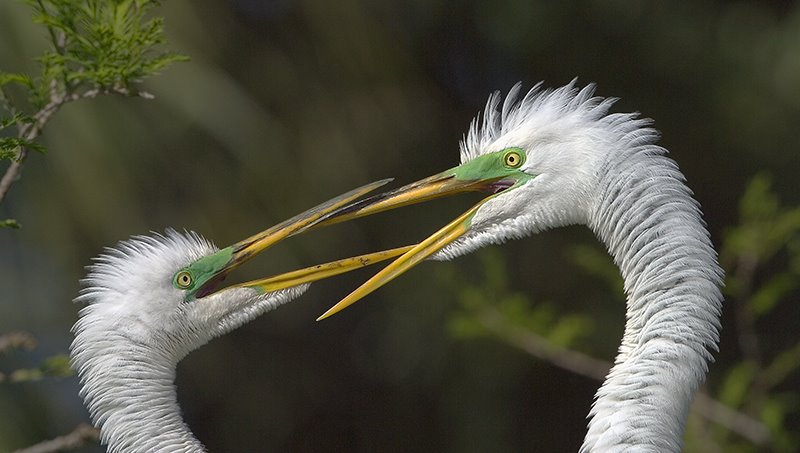
DANCING BEAK TO BEAK


Great Egret (Ardea alba)
Photo: © 2004 Jeff Berger

For the great egret, the breeding season begins when hormones cause the bare skin around the beak and eyes to change from yellow to green. The male builds a makeshift nest and invites a female to cohabitate thus signaling courtship. The nuptial pair announce their reproductive readiness by crossing beaks and fluffing up their feathers.

2.01.2011

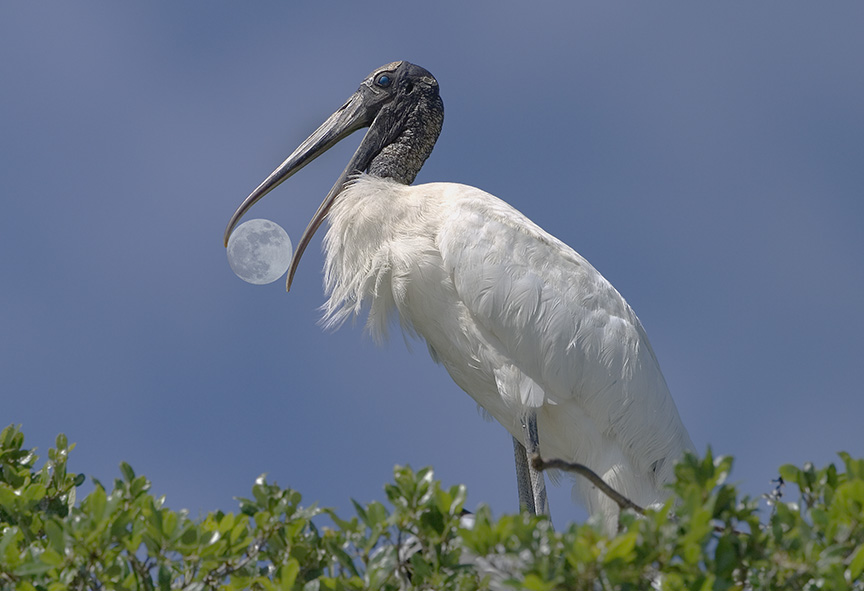
NORTH AMERICAN WOOD STORK


Scientific name: Mycteria americana
Photo: © 2004 Jeff Berger

The only stork found in North America is an endangered bird and one of my favorites. When walking or wading, they skulk around appearing serious and grim; I call them graveyard birds. When airborn, the wood stork is a truly magnificent flier - soaring from thermal to thermal on outstretched wings spanning five to six feet across. The nicknames “Flinthead” and “Ironhead” describe the slate-grey skin covering the neck and head.

Wood storks are especially susceptable to natural and man-made events. Storms and cold spells may lead to nest desertion. Racoons may predate eggs and fledglings. Major threats to long-term survival include loss of wetlands due to development and disruptive water management practices that alter their reproductive cycle.

Like other native birds, the wood stork depends upon gators to protect the breeding colony from tree-climbing predators.

10.01.2010

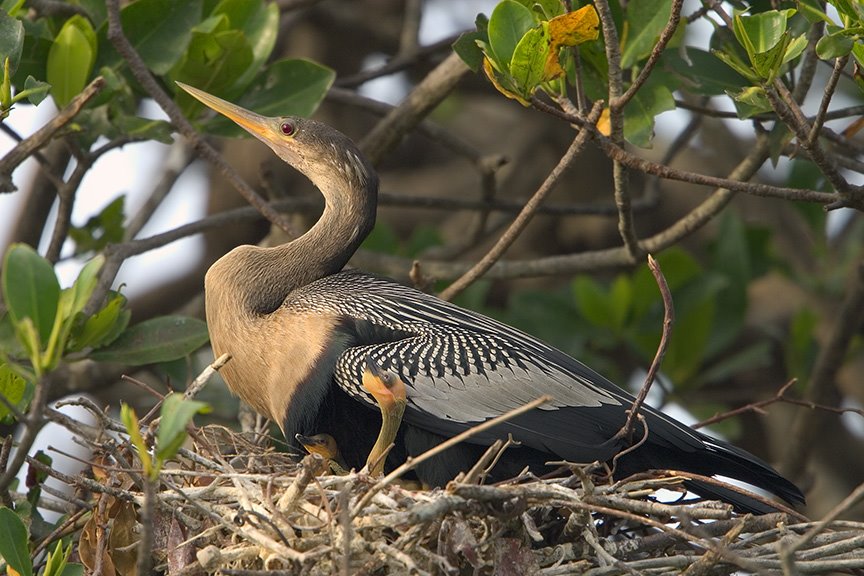
ANHINGA MOTHER


Scientific name: Anhinga anhinga
Location: Indian River Lagoon
Photo: © 2005 Jeffrey Berger

Anhinga mothers will lay an average of 3 to 5 eggs per nest spaced a day or two apart. Since incubation begins with the first egg, hatchlings will vary in age and size resulting in brood reduction.

The Anhinga has earned various nicknames depending upon how you experience one. Veteran boaters call it the “snakebird.” It earns this nickname by swimming submerged with only its neck and head undulating above the waterline like a serpent. The lack of waterproof plumage enables it to travel effortlessly underwater in search of fish, but for every advantage there is also a hitch. When soaked to the skin, the Anhinga looses body heat and must find a nearby perch to warm itself after feeding. With spread wings and fan-shaped tail feathers drying in the sun, the Anhinga earns its other nickname, “water turkey.”

9.20.2010

ZSA ZSA RETURNS


Roseate Spoonbill (Ajaia ajaja)
Location: Brevard County
Photo: © 2008 Jeffrey Berger

Ahh, my favorite roseate spoonbill is back ... as pink and sassy as ever!

8.01.2010

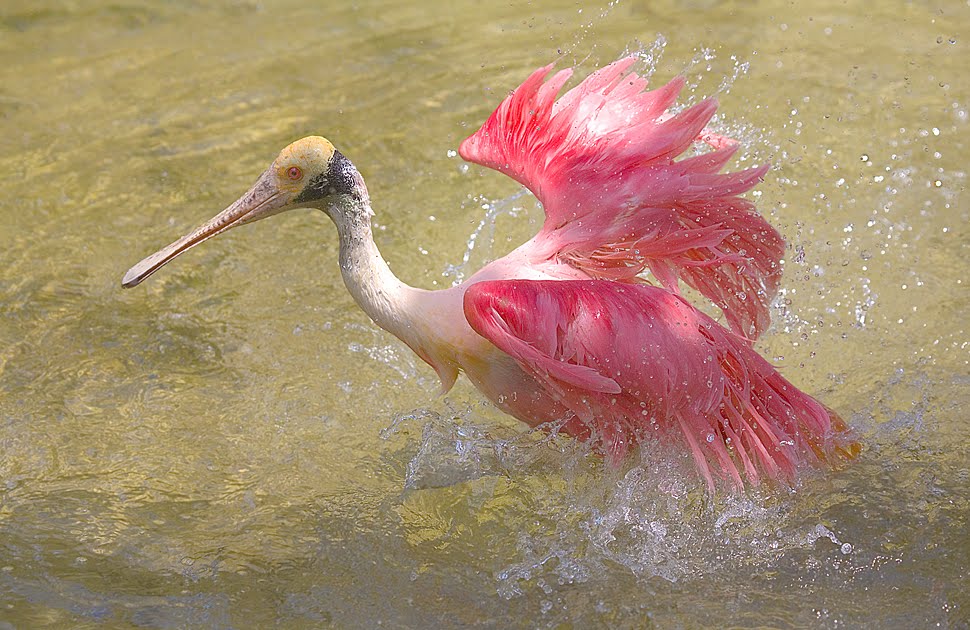
MEET ZSA ZSA


Roseate Spoonbill (Ajaia ajaja)
Photo: © 2004 Jeffrey Berger

Zsa Zsa is a beautiful and flamboyant bird, and the only spoonbill native to North America. The term “Roseate Spoonbill” refers to the rose-colored feathers and spatula-shaped beak. She is a tactile feeder who snatches aquatic insects and crustaceans from shallow water.

The spoonbill was almost exterminated in the last century. The demand for colorful plumes by the fashion industry had driven up the price of feathers to more than twice their weight in gold. Plume hunters armed with clubs and guns plundered the rookeries and slaughtered birds by the thousands. Today, spoonbills are threatened by the loss of feeding and nesting habitats due to unmanaged growth.

5.25.2009

WOOD DUCK


WOOD DUCK (Aix sponsa)
Location: Brevard County FL
Photo: © 2004 Jeffrey Berger

This photo of a wood duck is dedicated to my good friend, Peter Schutté, who passed away in 2005. Even after a passage of years, I still think of Peter who was a dedicated and tireless conservationist. He served on the Board of Directors of the Sea Turtle Preservation Society.

Peter and I found this dabbler on a day excursion. It was our last outing together before he died. This photo hangs in the Capital Building, a contribution to the Florida State Art Collection in Peter’s memory.

11.29.2008

THANKSGIVING 2008


Wild Turkey (Meleagris gallopavo)
Location: Homosassa Springs State Wildlife Park
Photo: © 2008 Jeffrey Berger
For my own part I wish the Bald Eagle had not been chosen the Representative of our Country. He is a Bird of bad moral Character. He does not get his Living honestly.
Thus wrote Ben Franklin in a letter to his daughter dated January 26, 1784. Old Ben regarded the wild turkey as "a true native American" and the bald eagle as an ignoble snatch-thief who purloins fish from honest ospreys. In retrospect, had the choice of national bird been reversed, it is hard to imagine a plump gobbler with cranberries and yams ensconced on our currency.

The wild turkey is the second largest bird in North America, and the toms are truly handsome critters with iridescent feathers. A mature gobbler may stand 4 feet tall and weigh up to 24 pounds with wings spanning 5 feet across.

In truth, both the wild turkey and the bald eagle are native to the Americas.  However, Americans cannot lay exclusive claim to either species, since both range from Canada to Mexico.

3.13.2008

GOLDEN-SILK SPIDER WITH FUZZY BOOTIES


Golden-Silk Spider (Nephila clavipes)
Photo: © 2008 Jeffrey Berger

A common inhabitant of swamps and woodlands, the golden-silk spider is harmless to humans and beneficial to the environment.

1.25.2008

THE BLUES BROTHERS


Black Vulture (Coragyps altratus)
Photo: © 2008 Jeffrey Berger

To those of you unfamiliar with Mount Dora, Gilbert Park is a lakeside recreational area where townsfolk flock to feed the ducks and watch a sunset.

But be forewarned: Mount Dorans loathe those Addams Family pets strafing the neighborhood. They will feed any duck to amuse themselves, but sooner rid their lake of any scavenger (or refer them to Lou Dobbs for deportation).

Too bad vultures get such a bad rap. I think of them as the waste management service of road kill. Their favorite foods include flat cats, rigor mortis tortoise, and poodles with noodles.

Like our retirees, vultures are smart and thrifty shoppers who proudly declare: “Of course, we prefer prime beef, but you can’t beat carrion for availability and price.”

12.05.2007

DOODLES ON THE SCRATCH PAD OF TIME


Ghost Crab (Ocypode quadrata)
Photo: © 2004 Jeffrey Berger

"As we conclude our lecture, ladies and gentlemen, this fossilized specimen, estimated to be over 100,000 year old, bears an uncanny relationship to the modern crab. Yet, the question remains: Is this an example of evolution or intelligent design? What say you all?"

Click. Clack.
Clickity clack.
Click. Clack.
Clickity clack.
So say we all
.

9.30.2007

A LOG-IN-A-BOG BLOG


American Alligator (Alligator mississippiensis)
Location: Everglades
Photos: © 2007 Jeffrey Berger

Like icebergs, there is more to a submerged gator than meets the eye. So how big is this one, you ask? Introducing Swampcracker’s First Law of Gator Measurement:

Since every inch of jaw is equivalent to a foot of gator, estimate the distance from the tip of the snout to the eye sockets in inches and translate into in feet. For this gator, ten inches from eyes to snout means a total estimated length of ten feet.

Despite having a fierce reputation, alligators are harmless to humans until they reach 8 feet.  However, you should NEVER FEED a gator. Once accustomed to handouts from humans, they become a nuisance and must be sacrificed.  Remember: "A fed gator is a dead gator.”

6.04.2007

A PELICAN BRIEF


Brown Pelican (Pelecanus occidentalis)
Location: Longpoint, Melbourne Beach
Photo: © 2004 Jeffrey Berger


American White Pelican (Pelecanus erythrorhynchos)
Location: Indian River Lagoon at Sebastian
Photo: © 2004 Jeffrey Berger

Our ubiquitous Brown Pelican has often been described as solemn, dignified, comical, and pompous. When pouched bills are pressed against breast, I think of them as pterodactyls masquerading as English butlers.

It is easy to tell the difference between our year-round Brown versus the migratory White, which visits our coasts only during the winter months. Our full-time resident sports a yellow crown and white neck ascending from its gray-feathered body. In contrast, our visitor from the North is a much larger bird with bright white feathers and black wingtips, visible only in flight.

When feeding, Brown Pelicans are spectacular plunge-divers that capture their meals with a splash. In contrast, American White Pelicans forage in groups, surrounding then scooping prey into their bills while swimming.

Whether small or large, native or visitor, here is a fitting tribute for all pelicans:

A wonderful bird is a pelican,

His bill will hold more than his belican.

He can take in his beak

Food enough for a week;

But I'm damned if I see how the helican.

(The Pelican by Dixon Lanier Merritt - often misattributed to Ogden Nash.)

5.11.2007

TREETOP DINING


Scientific Name: Anhinga anhinga
Location: Wakodahatchee Wetlands, Delray Beach
Photo: © 2007 Jeffrey Berger

As anhinga fledglings grow older, they reach into their parent's throat to retrieve solid food. Meanwhile, other siblings wait their turn.

Most birds lay their eggs, not all at once, but over a series of days. Since all eggs need the same time to incubate, hatchlings are born sequentially. Thus, the first egg hatches first, the last egg hatches last, and not all chicks start life as equal opportunity birds.

The first-born hatchling has no competition for food and grows rapidly. Chicks born later are consecutively smaller and weaker. Presumably, the first-born fledgling is the one feeding.

5.01.2007

PURPLE GALLINULE


Scientific Name: Porphyrula martinica
Location: Wakodahatchee Wetlands
Photo: © 2007 Jeffrey Berger

About the size of a chicken dipped in poster colors, the Purple Gallinule is not easy to find. In fact, those colors are a sublime example of camouflage.

The cool blues and purples of the undercarriage mimic the colors of sky reflected in water. Viewed from above, iridescent greens and olives mask the colors of marsh vegetation.

Oversized feet give it the agility to walk over and through marsh vegetation with ease. Nature’s attention to detail is incredible!

4.20.2007

LEAST BITTERN

JUVENILE:


ADULT:

Scientific Name: Ixobrychus exilis
Location: Wakodahatchee Wetlands
Photo: © 2007 Jeffrey Berger

1.17.2007

LITTLE GREEN TEMPER TANTRUM


GREEN HERON (Butorides virescens)
Location: Wakodahatchee Wetlands
Photo: © 2007 Jeffrey Berger

A mighty temper for a tiny critter. When annoyed or disturbed, the green heron leaves behind a chalk line (a stream of white excrement) as it flies away. In a manner of speaking, it is the way a bird throws you a bird. So be especially polite around the little green heron.

EDVARD GREBE


PIED-BILLED GREBE (Podilymbus podiceps)
Location: Wakodahatchee Wetlands
Photo: © 2007 Jeffrey Berger

The pied-billed grebe is the epitome of cute. When scared or threatened, they dive under water like miniature submarines. During the Plume Wars, grebes were hunted for their insulating feathers, called “grebe-fur.” Although protected, populations continue to decline due to habitat loss.

1.03.2007

OK, WHAT IS IT?


Photo: © 2007 Jeffrey Berger

No, this is not a one-eyed Jabba the Hutt. Guess the right answer (please use comment button below).